
Advanced Total Parenteral Nutrition (TPN)
The field of parenteral nutrition continues to evolve alongside advances in pharmaceutical technology, clinical nutrition and precision medicine. Current research focuses on improving lipid formulations, optimizing amino acid profiles, enhancing micronutrient stability and developing individualized nutritional therapies tailored to specific metabolic conditions. Automation in aseptic compounding, digital prescribing systems and increasingly sophisticated quality control technologies are also contributing to safer and more efficient production processes.
At the same time, the growing adoption of ready-to-use multi-chamber systems is simplifying clinical practice while preserving the flexibility needed for patient-specific nutritional management. TPN products are among the most demanding sterile medicinal preparations. That precision and formulation range create opportunities for further research and innovation in parenteral nutrition. As healthcare increasingly emphasizes personalized medicine, future TPN formulations are expected to integrate advanced metabolic monitoring with customized nutrient composition, further improving therapeutic outcomes for critically ill and chronically dependent patients.
Bram-Cor’s offering aligns with this approach; this is why, on this page, we present the ultimate utilities designed for a significant achievement in modern clinical research. TPN products are classified as Large Volume Parenterals (LVPs) and represent one of the most critical and highly regulated categories in sterile pharmaceutical manufacturing. These products are intended for direct intravenous administration and therefore require an absolute level of control over microbiological purity, particulate contamination, chemical composition, and physicochemical stability.
The standard TPN formulation
A TPN formulation typically comprises three principal sterile macronutrient streams::
- Glucose solutions (primary energy source)
- Amino acid solutions (nitrogen and protein synthesis support)
- Lipid emulsions (high-density caloric supply and essential fatty acids)
In addition to these three principal macronutrient streams, a complete parenteral nutrition formulation may contain electrolytes, vitamins and trace elements, according to the patient’s specific nutritional and metabolic requirements.
The general process flow involves formulation, conditioning, filler buffering and three-chamber filling. Each of these streams must maintain predefined Critical Quality Attributes (CQAs) throughout the entire lifecycle of the product, from formulation to final filling and storage. Each line is designed to operate under recipe-driven batch execution, where all process steps are controlled by validated automation systems in accordance with predefined electronic batch recipes. Typical CQAs for Total Parenteral Nutrition products include:
- Sterility assurance level (SAL)
- Endotoxin levels
- Particulate contamination
- Assay/concentration accuracy
- pH and osmolality
- Lipid droplet size distribution (for emulsions)
- Physical and chemical stability
- Nutrient compatibility over shelf-life
Engineering & compliance philosophy
Due to this complexity, TPN manufacturing requires a process-centric design approach based on Quality by Design (QbD) principles, where product quality is assured through robust process understanding and control rather than final testing alone. Within this framework, Critical Process Parameters (CPPs) such as mixing energy, temperature profiles, transfer rates, filtration differential pressure, homogenization pressure, and filling accuracy must be continuously controlled to ensure consistent achievement of CQAs.
Thus, the Bram-Cor TPN Manufacturing Platform is developed to scrupulously respect a Quality by Design (QbD) methodology, integrating pharmaceutical engineering, contamination control strategy, and automation into a unified GMP-compliant system. The design intent is based on four core principles:
- Assurance of product CQAs
- Robust control of CPPs
- Maintenance of a closed and controlled aseptic boundary
- Full compliance with regulatory expectations (Annex 1 and 21 CFR Part 11)
The system architecture is built around closed processing, minimizing product exposure to the external environment through:
- Fully enclosed vessels and piping systems
- Hygienic design (sanitary valves, drainability, dead-leg minimization)
- Automated transfer systems
- Integrated filtration and homogenization stages
- CIP/SIP validated cleaning systems
This design philosophy ensures a high level of sterility assurance and supports modern contamination control strategies required by Annex 1.
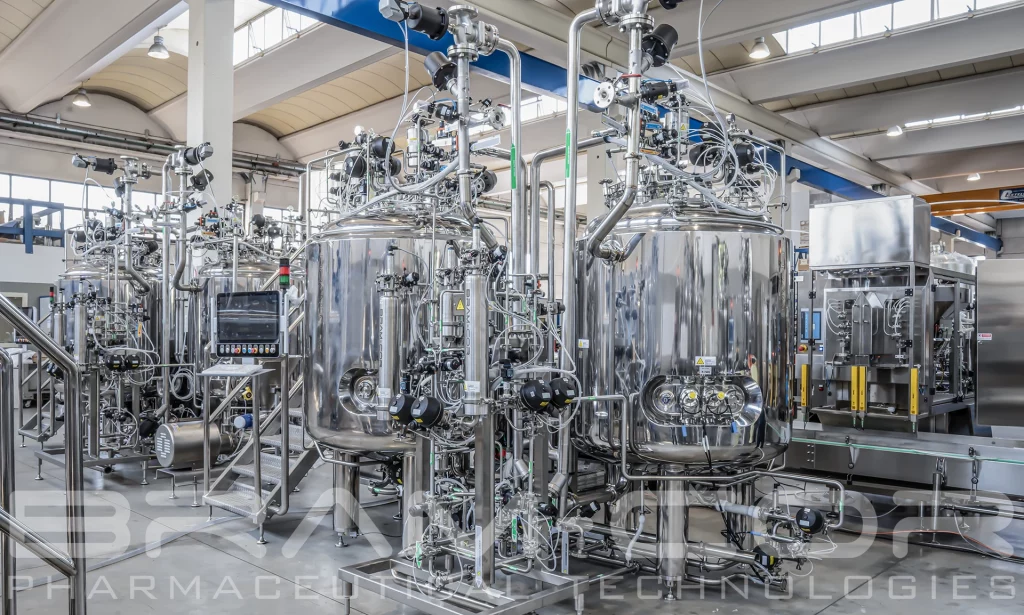
Closed processing and aseptic boundary definition
A key design principle of the platform we present is the establishment of a controlled aseptic boundary, encompassing:
- Formulation vessels
- Transfer lines
- Filtration systems
- Buffer tanks
- Filling machines
This boundary is maintained through:
- Closed connections (aseptic valves, hygienic fittings)
- CIP/SIP cycles
- Sterile filtration barriers (where applicable)
- Controlled pressure cascades
- Automated valve sequencing
The system is designed to minimize manual interventions, reducing contamination risk and ensuring compliance with EU GMP Annex 1 contamination control strategy (CCS) requirements.
Everything under control: digitalization and recipe-driven batch execution
The entire manufacturing process is executed via recipe-driven batch execution, ensuring full standardization and traceability. This is a key feature of the system proposed by Bram-Cor. Each recipe governs:
- Ingredient sequencing
- Agitation profiles
- Temperature control curves
- Transfer logic
- Filtration parameters
- Homogenization settings
- Filling parameters
- Cleaning cycles (CIP/SIP)
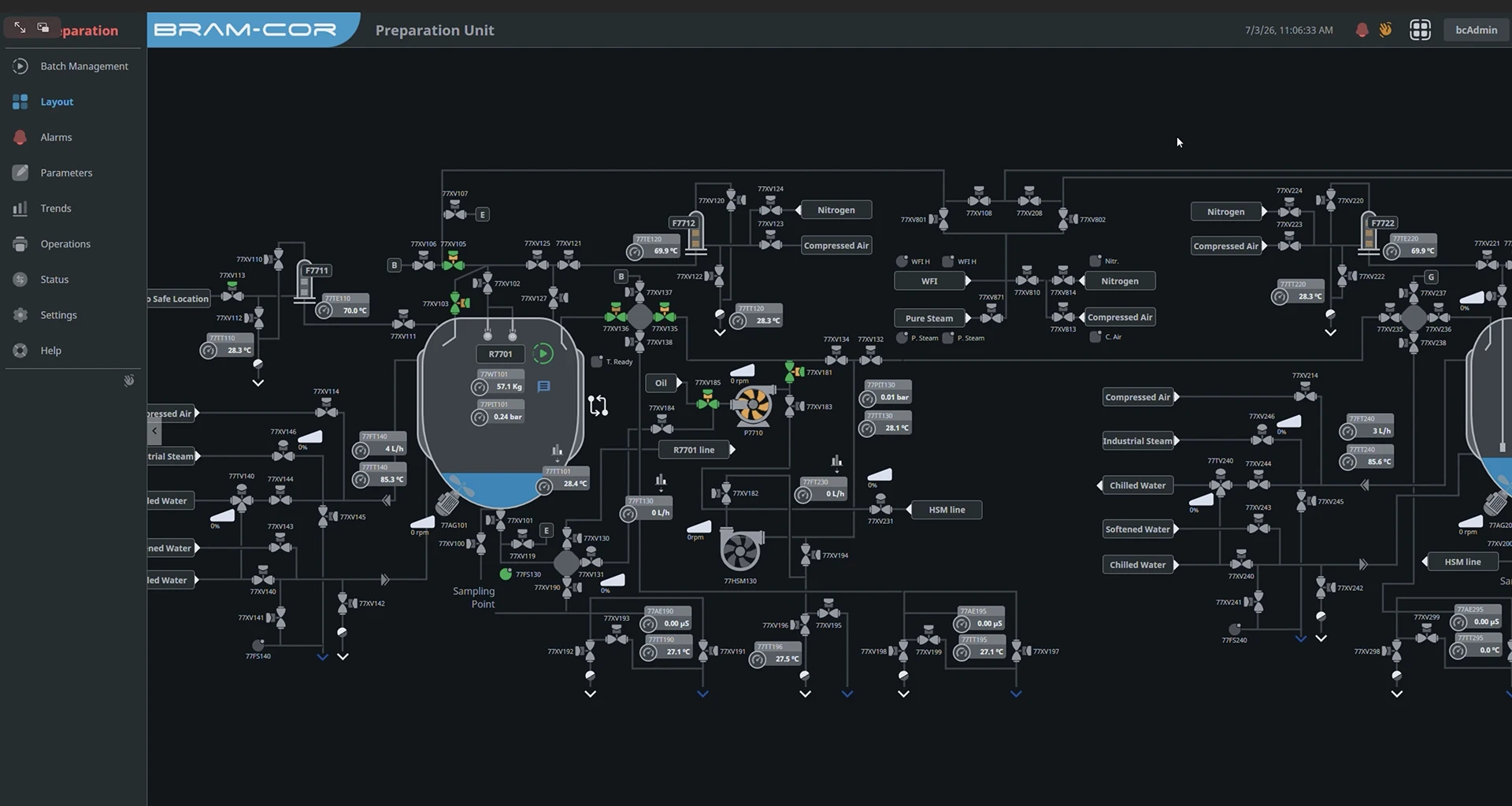
The automation system supports full electronic batch management. Thanks to the modular software that runs as a browser, the entire system is manageable from any device, with no location constraints. This is an extraordinary comprehensive overview: a single interface to monitor every process, every parameter. Every machine is connected, recorded and tracked in full GMP compliance. With all machinery connected, the Bram-Cor TPN plant communicates as a unified organism. In the image below, you can see the modular software in action while the vessel is filled.
Glucose solutions line, the first stream
Glucose is the principal carbohydrate used in parenteral nutrition and represents the body’s preferred immediate source of metabolic energy. Following intravenous administration, glucose is rapidly transported into cells under insulin regulation, where it undergoes glycolysis and oxidative phosphorylation to generate adenosine triphosphate (ATP), the universal cellular energy carrier. Providing sufficient glucose reduces endogenous protein breakdown by limiting gluconeogenesis from skeletal muscle amino acids. This protein-sparing effect is one of the primary objectives of TPN therapy. Depending on the patient’s metabolic condition, glucose generally supplies between 50% and 70% of the total non-protein caloric intake.
Higher concentrations possess elevated osmolarity and therefore require administration through central venous access to minimize the risk of vascular irritation and thrombophlebitis. Because glucose solutions support microbial proliferation, absolute sterility throughout manufacturing, filling, storage and administration is mandatory. Conversely, insufficient glucose intake promotes protein catabolism and impaired energy metabolism. Clinical guidelines generally recommend maintaining glucose infusion rates below the patient’s maximum oxidative capacity to avoid metabolic overload.
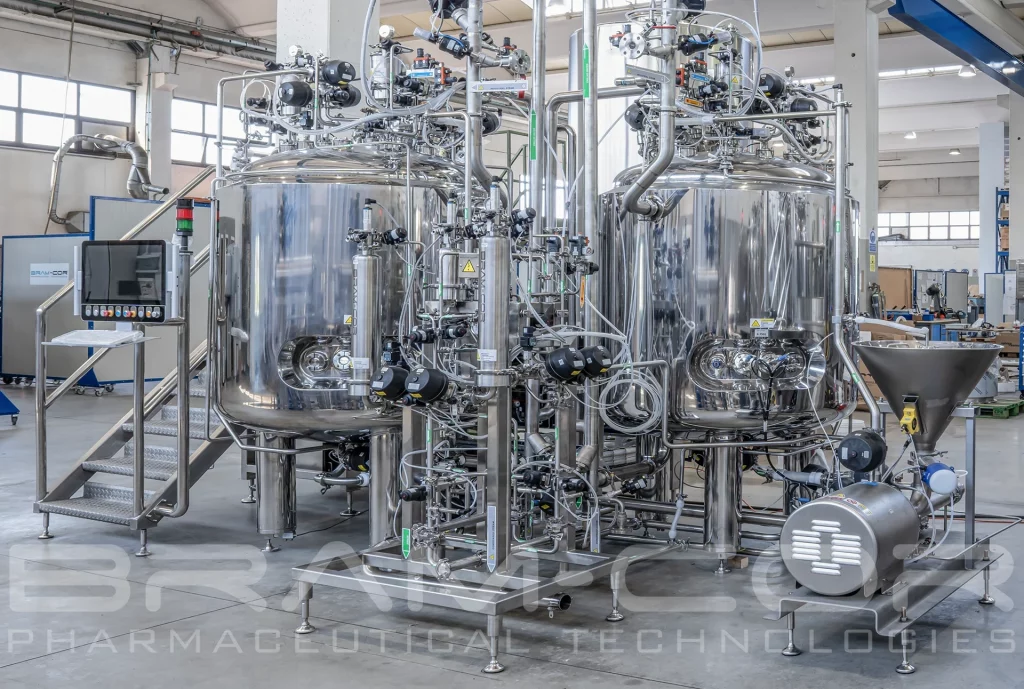
A key feature of the line is the integration of a Tri-blender powder induction system, directly connected to the formulation vessel. This system enables controlled powder addition under closed conditions, ensuring:
- Optimized powder wetting
- Prevention of agglomerates
- Improved dissolution kinetics
- Reduced operator exposure
- Enhanced batch reproducibility
Following formulation, the solution is processed through a dedicated double-filtration system, integrated within the skid architecture. This filtration stage contributes to:
- Particulate reduction
- Product clarification
- Protection of downstream filling equipment
- Enhancement of process robustness
Amino acid solutions line, the second stream
Unlike carbohydrates and lipids, amino acids primarily serve structural rather than energetic functions. They provide the nitrogen necessary for protein synthesis, tissue regeneration, enzyme production, hormone synthesis and immune function.During severe illness, trauma or surgery, protein turnover increases substantially. Without adequate amino acid supplementation, skeletal muscle becomes the principal source of endogenous amino acids, leading to progressive loss of lean body mass. Intravenous amino acid solutions are specifically formulated to prevent this catabolic state.
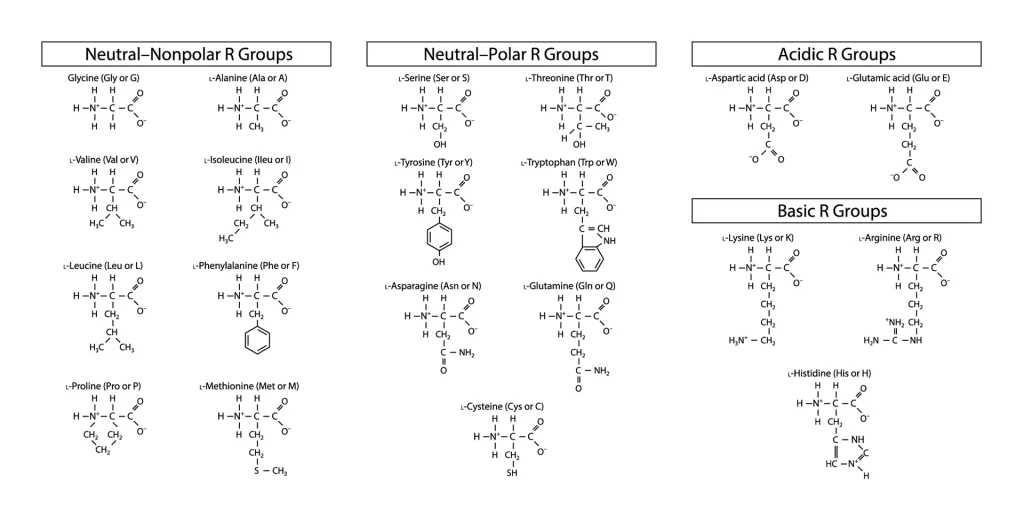
Modern amino acid solutions contain carefully balanced mixtures of essential and non-essential amino acids designed to approximate physiological metabolic requirements. Essential amino acids include:
- leucine;
- isoleucine;
- valine;
- lysine;
- methionine;
- phenylalanine;
- threonine;
- tryptophan;
- histidine.
Non-essential amino acids contribute additional substrates required for cellular metabolism and nitrogen balance. Specialized formulations are also available for patients with liver failure, renal insufficiency or neonatal nutritional requirements, in which the amino acid profile is modified to accommodate altered metabolic pathways. The manufacture of amino acid solutions presents significant pharmaceutical challenges. Each amino acid must meet strict pharmacopoeial purity specifications while remaining chemically stable throughout production and storage. Oxidation, racemization and degradation reactions must be minimized through optimized formulation, controlled pH and appropriate packaging materials. Water quality plays a particularly important role because dissolved impurities or microbial contaminants may accelerate degradation reactions or compromise product sterility. Consequently, pharmaceutical manufacturers employ Water for Injection produced according to internationally recognized pharmacopoeial standards. The effectiveness of amino acid therapy is commonly evaluated by monitoring nitrogen balance.
Following formulation, the amino acid solution also undergoes treatment via a dedicated dual-filtration system integrated into the skid architecture.
Lipid emulsion line, the third stream
Lipid emulsions constitute the third major component of traditional Total Parenteral Nutrition (TPN). Beyond serving as a highly concentrated source of energy, they supply essential fatty acids that cannot be synthesized by the human body and are therefore indispensable for maintaining normal cellular function. Compared with glucose, lipids provide approximately 9 kcal per gram, more than twice the caloric density of carbohydrates and amino acids. This high energy content allows clinicians to meet caloric requirements while limiting fluid volume, an important consideration in critically ill patients, neonates and individuals with restricted cardiovascular or renal function. In addition to their energetic role, lipids contribute to the structural integrity of cell membranes, participate in intracellular signaling pathways, support immune function and provide precursors for numerous biologically active mediators involved in inflammation and tissue repair.
Unlike glucose and amino acid solutions, lipids are naturally insoluble in water and therefore cannot simply be dissolved into an aqueous infusion medium.To enable safe intravenous administration, triglycerides are dispersed as microscopic oil droplets suspended in water, forming an oil-in-water emulsion. These droplets are stabilized by emulsifying agents, principally purified egg phospholipids, which prevent coalescence and maintain uniform particle size throughout the product’s shelf life. The average droplet diameter is generally well below one micrometre, closely resembling the physiological dimensions of endogenous chylomicrons. Maintaining this small particle size is essential because oversized lipid droplets may increase the risk of vascular obstruction and compromise patient safety. The physical stability of the emulsion therefore represents one of the most critical quality attributes of pharmaceutical lipid preparations.
In TPN production, the third stream requires an advanced, composite process to produce a state-of-the-art lipid emulsion. While the glucose and amino acid lines are consolidated by world standards, the ability to offer highly evolved, specialized emulsions represents the most exciting frontier in marketing three-chamber bags. Lipids are naturally insoluble in water. To enable safe intravenous administration, triglycerides are dispersed as microscopic oil droplets suspended in water, forming an oil-in-water emulsion. These droplets are stabilized by emulsifying agents, which prevent coalescence throughout the product’s shelf life. A dedicated homogenization stage ensures strict control over droplet size distribution, emulsion stability, physical integrity of the formulation, and compliance with parenteral emulsion specifications.
Advanced process control, fully open formulation, precision in the homogenization stage, high-quality filling with buffering: these are the reasons of the superior design required by this stream, as is the case with the Bram-Cor systems shown here, where every step remains fully traceable, forever.
The final stage: the filling of the three-chamber bags
In operating conditions, the final stage will consist of automated filling of the three-chamber parenteral nutrition bags — three chambers, three fillers, each filled independently. Chamber one will host a glucose solution, chamber two an amino acid solution and chamber three a lipid emulsion. In Bram-Cor system there are three dedicated buffer tanks, one for stream, connected to a single filling machine. These vessels function as sterile surge tanks designed to decouple formulation from filling operations, stabilize flow conditions, maintain constant inlet pressure to filling systems and ensure uninterrupted production. Filling buffers are fully integrated within the aseptic boundary and operate under closed processing conditions. The three-chamber configuration of the final product will ensure: physical separation of incompatible components, preservation of critical quality attributes during shelf-life, activation of final mixture only prior to administration.
The bags filling system product by Bram-Cor is fully automated and designed for high dosing accuracy, sterile handling within the aseptic boundary, repeatable cycle execution, and — obviously — full GMP compliance.
Clinical indications for Total Parenteral Nutrition
Total Parenteral Nutrition is indicated whenever the digestive tract cannot be used safely or effectively for nutrient absorption. Unlike enteral nutrition, which exploits the physiological digestive pathway, TPN bypasses the gastrointestinal system entirely by delivering nutrients intravenously, typically through a central venous catheter. Common indications include:
- Short bowel syndrome
- Severe inflammatory bowel disease
- Intestinal obstruction
- Gastrointestinal fistulas
- Severe pancreatitis
- Major gastrointestinal surgery
- Extensive burns and trauma
- Critical illness requiring prolonged nutritional support
- Certain oncological conditions associated with intestinal failure
- Premature neonates with immature gastrointestinal function
In these patients, inadequate nutritional intake rapidly leads to protein catabolism, impaired immune response, delayed wound healing and increased susceptibility to infection. Carefully designed TPN formulations compensate for these deficiencies by supplying all essential macronutrients together with electrolytes, vitamins and trace elements according to individual metabolic requirements. The composition of a TPN regimen is highly personalized. Age, body weight, renal and hepatic function, disease state, energy expenditure and laboratory parameters all influence the daily prescription. Consequently, parenteral nutrition requires close collaboration among physicians, pharmacists, nutrition specialists and nursing staff.